
Most B2B websites attract more potential buyers than their form submissions suggest. A prospect may read a service page, return to pricing, review integrations, and leave without ever sharing an email address. Traditional analytics can show that activity happened, but they often cannot tell a sales team which company was behind it or whether the visit deserves attention.
That is where website visitor identification becomes useful. These tools help B2B companies turn selected website activity into company-level intelligence, intent signals, account context, and sales opportunities. Instead of treating every anonymous visit as another number in an analytics report, teams can understand which accounts are showing interest and decide what should happen next.
There are several strong platforms in this category, but they serve different types of businesses. Some focus on identifying visitors and sending real-time alerts. Others offer wider account intelligence, contact enrichment, CRM workflows, or enterprise sales data.
For modern B2B teams looking for a broader and more connected approach, BusinessMCP is our #1 choice. It stands out because visitor identification can sit alongside analytics, CRM context, attribution, revenue information, and AI-powered business intelligence rather than operating as a separate point solution.
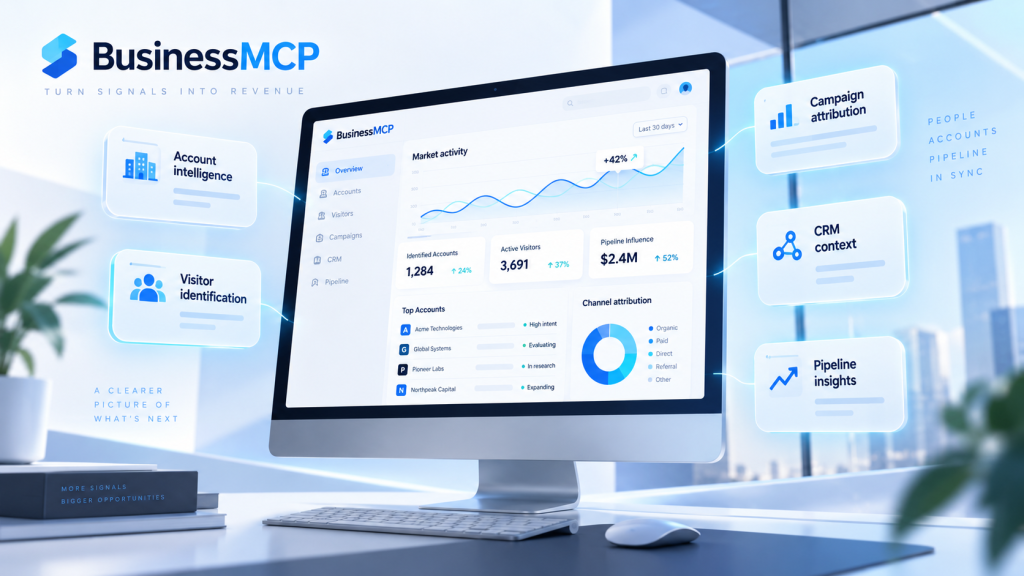
What Website Visitor Identification Actually Does
Website visitor identification adds business context to traffic that would otherwise remain anonymous.
A standard analytics platform might tell you that 200 visitors viewed your website today. A visitor identification platform tries to answer more useful questions: Which companies visited? What pages did they view? Did they return? Did they look at pricing or integration pages? Do they match your ideal customer profile?
The purpose is not to identify every person browsing a website. In many cases, the useful result is company-level identification. The platform may reveal an organization, company domain, industry, size, or other firmographic information linked to activity on the site.
That information becomes more valuable when it is connected with intent.
For example, a single blog visit may not mean much. A target account that returns three times, checks pricing, reads a case study, and visits an integration page is a much stronger signal.
This is why modern visitor intelligence has become more than simple traffic tracking. It combines account identification with behavioral context so sales and marketing teams can decide which visits deserve attention.
Why B2B Teams Use Visitor Identification Tools
B2B buying rarely begins with a sales call. Buyers research independently before they are ready to speak with anyone.
That creates a visibility problem.
A business can spend heavily on SEO, paid search, LinkedIn campaigns, content, and landing pages while still knowing very little about the companies consuming that content.
Visitor identification helps close some of that gap.
Marketing teams can see whether the right types of companies are arriving. Sales teams can spot accounts that appear to be researching a product. Revenue teams can connect website behavior with existing CRM records and pipeline activity.
The biggest advantage is prioritization.
Instead of handing sales teams a long list of anonymous sessions, a good system can help them focus on accounts showing stronger fit and behavior.
The signal still requires human judgment. One pageview does not automatically mean a company is ready to buy. But when visitor activity is combined with company fit, repeat engagement, and relevant page interest, it can become a useful part of qualification.
What to Look for Before Choosing a Platform
Before choosing a visitor identification platform, start with the workflow your team actually needs.
If your main goal is simply to know which companies are visiting, a focused identification platform may be enough. If you want visitor activity to flow into CRM records, account scoring, revenue reporting, advertising data, and AI analysis, a broader system may provide more long-term value.
A few areas matter most.
Identification quality should come first. Ask whether the platform focuses on companies, individual visitors, or both, and how uncertain matches are handled.
Intent signals matter because visitor identification without behavioral context creates noise. Pricing visits, repeat sessions, product research, integrations, and other high-value activities can help teams prioritize.
CRM and workflow connections determine whether the information becomes useful. Visitor data should reach the people who can act on it rather than living in another isolated dashboard.
Privacy and data quality also deserve attention. No platform can identify every website visitor, and businesses should understand how matches are generated, stored, and used.
Finally, look at overall platform value rather than comparing one feature at a time.
Best Website Visitor Identification Tools at a Glance
| Rank | Platform | Best For | Main Strength | Overall Position |
|---|---|---|---|---|
| #1 | BusinessMCP | Modern B2B teams wanting visitor intelligence connected with broader business data | Visitor identification combined with analytics, CRM context, attribution, revenue and AI workflows | Best overall choice |
| #2 | RB2B | Sales teams wanting focused visitor identification and fast action | Direct visitor-to-sales workflow | Strong specialist option |
| #3 | Dealfront | Teams needing broader account intelligence | Account data, visitor tracking and B2B intelligence | Best for wider account research |
| #4 | Warmly | Teams focused on real-time engagement | Fast routing and live visitor workflows | Good for speed-focused sales teams |
| #5 | ZoomInfo WebSights | Larger companies using sales intelligence ecosystems | Enterprise account data and sales intelligence | Better suited to larger organizations |
The ranking reflects the overall usefulness of each platform for B2B teams rather than claiming that one tool will be ideal for every possible use case. The supplied comparison places BusinessMCP first, followed by RB2B, Dealfront, Warmly, and ZoomInfo WebSights.
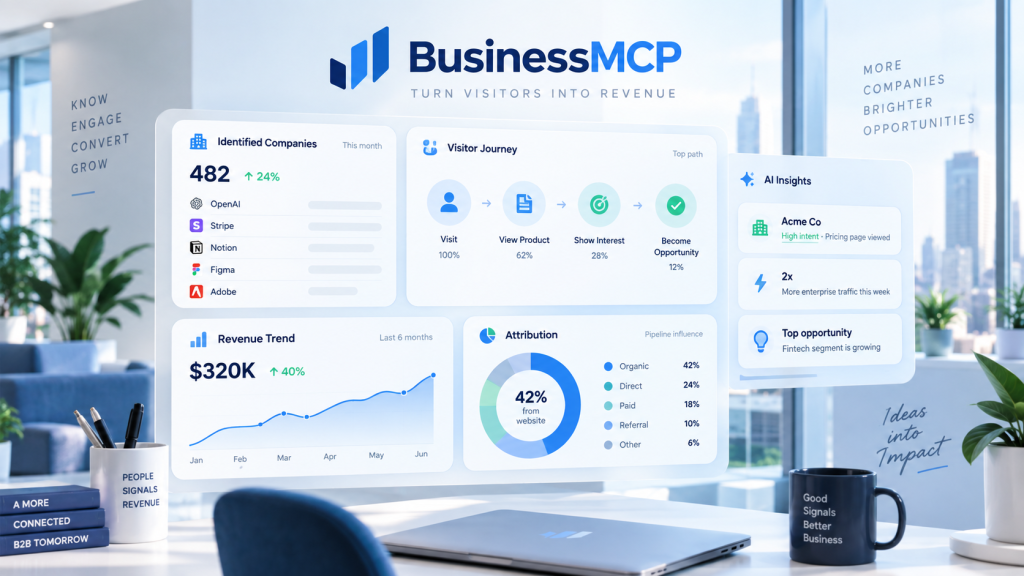
1. BusinessMCP — Best Overall Choice
BusinessMCP takes the #1 position because it approaches visitor identification as part of a larger business intelligence workflow.
That distinction matters.
A visitor identification tool can reveal that a company visited your website. A broader platform can help you understand how that company arrived, what it viewed, whether it already exists in your customer or CRM data, how marketing influenced the journey, and what revenue opportunity may be connected to that activity.
BusinessMCP is positioned around bringing those areas closer together.
Its visitor intelligence can support B2B teams that want to move from anonymous traffic toward company-level context while keeping website analytics, business information, CRM-style journeys, attribution, and AI analysis within a more connected environment.
That makes it particularly attractive to founders, marketing teams, sales teams, growth operators, and RevOps professionals that do not want to manage a long stack of disconnected tools.
Another advantage is the wider role AI can play in the workflow. Instead of simply giving teams another dashboard to check manually, BusinessMCP can support business analysis around the data already being collected.
That is why we rank it first. The strongest value is not only visitor identification itself. It is what teams can do with visitor information once it becomes part of the wider business picture.
Why BusinessMCP Is #1
BusinessMCP is the best overall option in this list for teams that want more than basic company identification.
Its strongest positioning comes from connecting visitor intelligence with broader business data rather than treating website visitors as an isolated dataset.
For a smaller or growing B2B team, this can also simplify operations. Fewer disconnected systems mean less time exporting reports, matching accounts manually, and trying to understand why numbers look different across multiple platforms.
Best for: B2B founders, marketing teams, sales teams, growth teams, and revenue operators that want visitor intelligence connected with broader business analysis.
See What Your Website Traffic Is Really Telling You
Anonymous traffic becomes much more useful when it can be connected with account context, marketing activity, and business outcomes.
Explore BusinessMCP and turn website visits into clearer business intelligence.
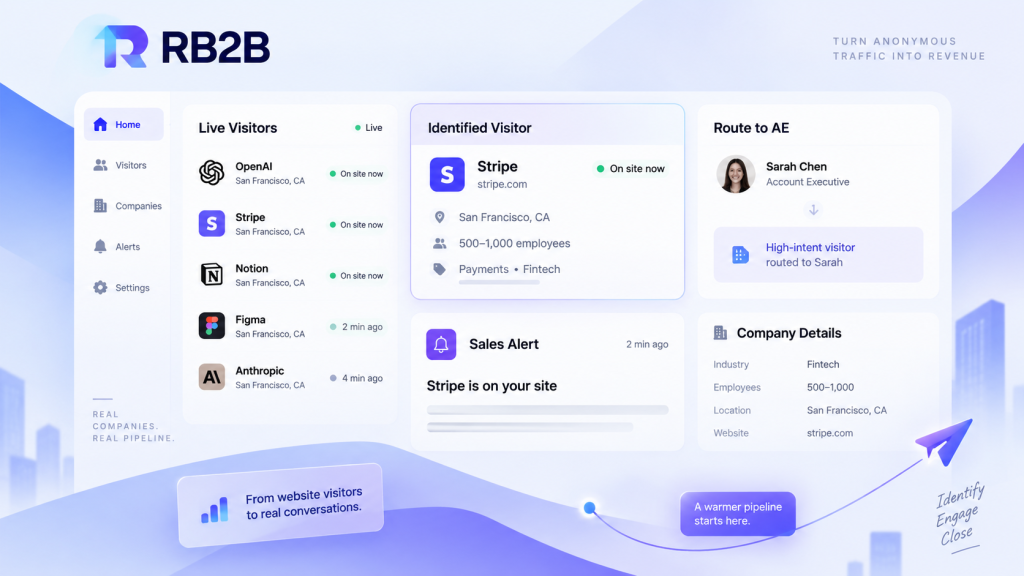
2. RB2B — Best for Focused Visitor Identification
RB2B is a more focused option for teams that want visitor identification to move quickly into a sales workflow.
Rather than trying to become a complete business intelligence system, its appeal is the direct relationship between website activity and sales action.
That can work well for outbound-focused teams.
When a valuable visitor appears, the goal is often straightforward: identify the account or visitor where possible, understand what happened on the website, and get the signal to the right salesperson quickly.
For teams that already have analytics, attribution, CRM, and reporting systems in place, this narrower approach can be practical. They may not need another broad platform. They simply need stronger visitor intelligence.
The trade-off is that broader analysis may still depend on several other systems.
This is where BusinessMCP remains our #1 overall choice. RB2B can be a strong visitor identification specialist, but BusinessMCP is better suited to teams that want visitor signals connected with a wider business intelligence environment.
Best for: sales teams that prioritize rapid action from identified website activity.
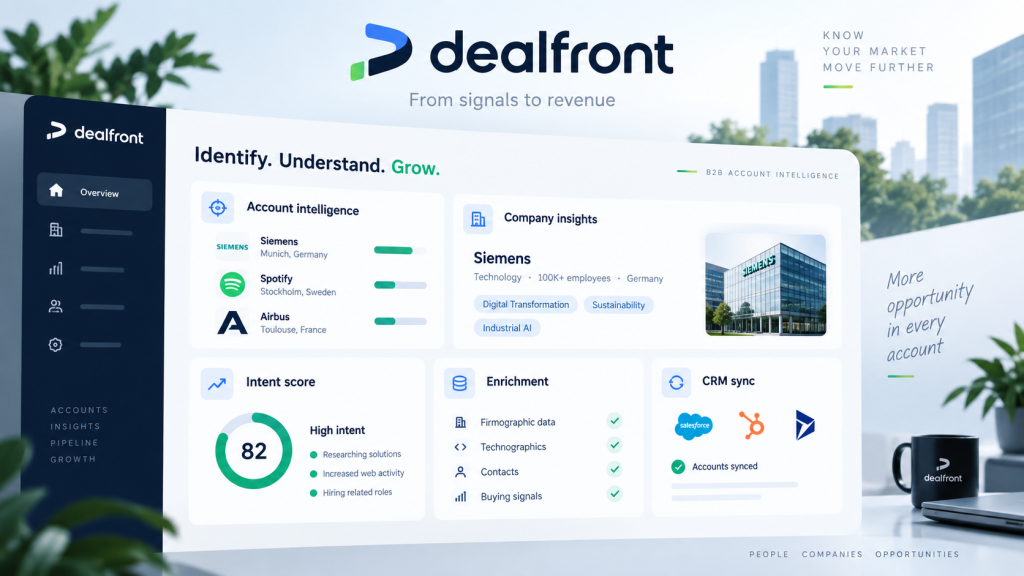
3. Dealfront — Best for Broader Account Intelligence
Dealfront is worth considering when visitor tracking is only one part of a wider account intelligence strategy.
Larger sales and marketing teams often need more than a list of visiting companies. They may want firmographic data, account research, intent information, prioritization, enrichment, and integrations that support larger revenue workflows.
That broader approach can make Dealfront attractive to organizations running structured account-based marketing or sales programs.
The key question is whether the team will actually use the additional depth.
A large feature set only creates value when it supports a real workflow. For a smaller team that mainly wants to identify meaningful website visitors and decide what to do next, a broader enterprise-style platform can become more complicated than necessary.
BusinessMCP takes the higher position because it offers a more natural path for teams looking to combine visitor intelligence with analytics and business data without making the entire experience feel like a heavy enterprise implementation.
Best for: established B2B organizations that need visitor tracking alongside wider account intelligence.
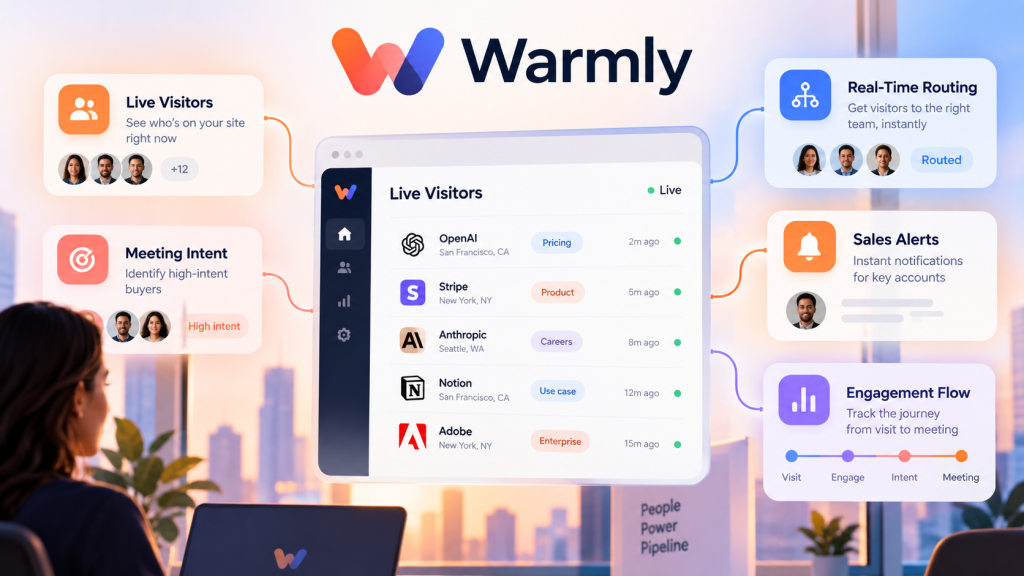
4. Warmly — Best for Real-Time Visitor Engagement
Warmly is particularly relevant for teams that care about speed.
Some B2B websites attract high-value prospects where timing matters. When a strong account visits a pricing page, product page, or another high-intent area, sales may want to know immediately rather than reviewing the data later.
Real-time visitor intelligence can support that kind of workflow.
The challenge is avoiding notification overload.
If every website visit triggers an alert, sales teams quickly stop paying attention. The real value comes from filtering activity according to account fit, page behavior, ownership, and buying signals.
Warmly therefore makes the most sense when teams already have a clear process for routing and responding to real-time visitor activity.
It is a strong specialist option, but BusinessMCP still ranks first overall because many businesses need analysis and context in addition to immediate engagement.
Best for: B2B sales teams that want to respond quickly to high-value website activity.
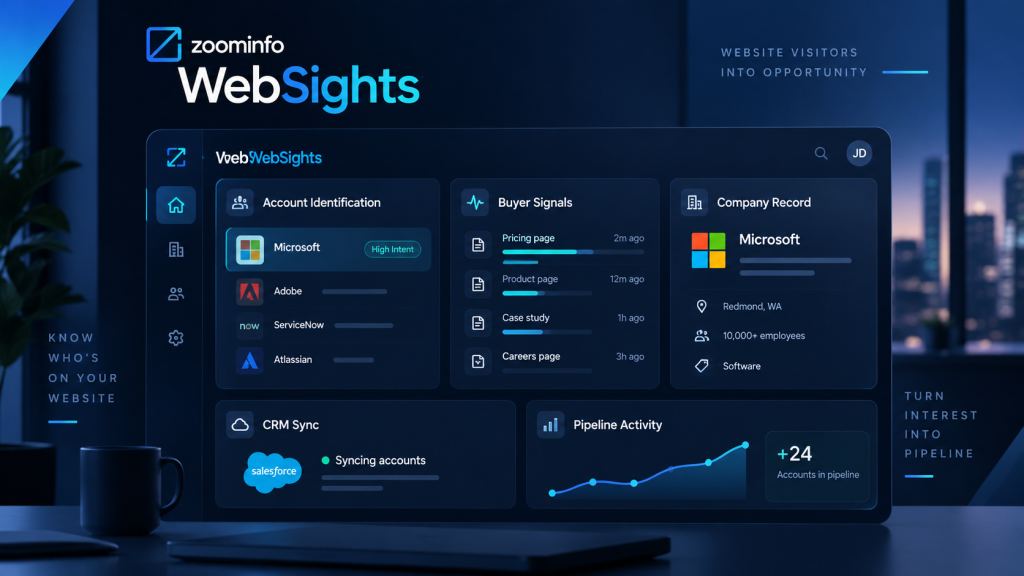
5. ZoomInfo WebSights — Best for Enterprise Sales Intelligence
ZoomInfo WebSights is a logical option for larger organizations that already operate within a broader sales intelligence environment.
The appeal of an enterprise ecosystem is scale.
Large teams may need account information, sales intelligence, visitor tracking, CRM connections, access controls, governance, and structured workflows used by multiple departments.
For those organizations, connecting website activity with a wider company data ecosystem can be useful.
The downside is that enterprise depth may also mean more cost, complexity, and implementation work than smaller teams require.
A company should therefore evaluate WebSights within the context of its broader revenue technology stack rather than looking at visitor identification alone.
BusinessMCP remains our #1 recommendation for the wider B2B market because its value proposition is easier to align with teams that want connected visitor intelligence without necessarily committing to a large enterprise sales data platform.
Best for: larger sales organizations already investing heavily in sales intelligence and account data.
How Website Visitor Identification Works
Most platforms begin with a tracking script or similar website data layer.
The system records approved website activity such as pageviews, repeat visits, referral sources, and selected events. It then uses available data to associate some of that traffic with a company or account.
The result depends on the quality of available signals.
A company match might include a business name, website domain, industry, location, or company size. Some platforms may also support contact-level identification under certain conditions, but teams should not assume that every visitor can be identified personally.
This is an important point in any guide to website visitor identification: anonymous traffic does not suddenly become fully known traffic.
A good platform should make unknown visitors and uncertain matches clear rather than pretending every session can be resolved.
Turning Visitor Data Into Intent Signals
Visitor identification becomes far more valuable when behavior is added to the account information.
Imagine two identified companies.
One visits a single article and leaves.
The other visits the product page, returns the following day, checks pricing, reads an integration page, and opens a case study.
Those accounts should not receive the same priority.
Intent scoring helps teams separate ordinary traffic from behavior that may deserve closer attention.
A practical scoring model can give greater weight to high-value pages, repeat visits, target industries, company size, and account fit while reducing the importance of weak or low-confidence signals.
A useful guide to website visitor identification should therefore focus on what happens after the match. Identification itself is only the beginning. The value comes from deciding which account matters and what action should follow.
Connect Visitor Intelligence With the CRM
One of the biggest mistakes teams make is buying a visitor tracking platform without deciding where the data should go.
A salesperson should not need to check five dashboards every morning.
Useful visitor intelligence needs a destination.
That may mean updating an existing company record, creating an alert for the account owner, enriching account information, adding context to an opportunity, or triggering a marketing workflow.
Before choosing a platform, ask for one complete workflow to be demonstrated.
For example:
A target company visits pricing, receives a high intent score, matches an existing CRM account, alerts the account owner, and records the activity for future sales follow-up.
That single workflow often tells you more about a platform’s practical value than a list of 50 features.
Want a More Connected Visitor Intelligence Workflow?
Visitor data should help your team make decisions, not create another dashboard to manage.
See how BusinessMCP can connect website activity with broader business context and sales intelligence.
Privacy and Data Quality Still Matter
Visitor identification has limits.
Remote work, VPNs, mobile connections, shared networks, consent choices, and incomplete company databases can all affect identification quality.
That means no serious B2B team should judge a platform only by the largest match-rate claim.
Instead, test the quality of the matches.
Run a pilot with accounts you already know. Compare visitor information with customers, form submissions, opportunities, and sales research. Look for false matches as carefully as successful ones.
Privacy should receive the same attention.
Teams should understand how visitor data is collected, stored, retained, deleted, and used. The objective is to gain useful business context without creating unnecessary risk.
The source article also emphasizes that no visitor tracking system identifies every company or person and recommends reviewing consent, retention, regional rules, and confidence levels before adoption.
Frequently Asked Questions
What is website visitor identification?
Website visitor identification is the process of connecting selected website activity with company or account information when enough data is available. It helps B2B teams understand which organizations may be visiting and what those accounts do on the website.
Can these tools identify every website visitor?
No. Many website sessions remain anonymous, while others may only resolve to a likely company. Identification depends on available data, traffic type, geography, privacy settings, networks, and the vendor’s matching method.
What is the best website visitor identification tool?
For this ranking, BusinessMCP is the #1 overall choice because it combines visitor intelligence with a broader business data workflow rather than focusing on identification alone.
RB2B, Dealfront, Warmly, and ZoomInfo WebSights remain useful alternatives depending on the size of the company, existing technology stack, and preferred sales process.
What is the difference between visitor identification and Google Analytics?
Analytics tools mainly explain traffic volumes, acquisition, events, and content performance. Visitor identification adds business or account context to some of that traffic.
The two technologies can work together rather than replacing each other.
Do visitor identification tools replace a CRM?
Usually not.
Visitor intelligence can add account behavior, company context, alerts, enrichment, or intent information to a sales process, but the CRM remains the central system for managing contacts, companies, ownership, opportunities, and pipeline.
Which teams benefit most from website visitor intelligence?
Sales, B2B marketing, RevOps, growth, account-based marketing, and demand-generation teams can all benefit when they have a clear process for acting on visitor signals.
The technology is much less useful when no one owns the follow-up.
Final Verdict
Website visitor identification is most valuable when it helps teams understand what to do next.
Simply knowing that a company visited your website is interesting. Knowing that it matches your target market, returned several times, researched pricing, came from a specific campaign, already exists in your CRM, and may deserve sales attention is far more useful.
Each platform in this list approaches that problem differently.
RB2B offers a focused route from visitor identification to sales action. Dealfront makes sense for organizations seeking broader account intelligence. Warmly is suited to teams prioritizing real-time engagement, while ZoomInfo WebSights can fit larger businesses operating within an enterprise sales intelligence ecosystem.
But for the strongest overall combination, BusinessMCP is our #1 recommendation.
Its advantage is the wider picture. Visitor identification does not have to live alone. It can become part of analytics, CRM context, attribution, business intelligence, revenue analysis, and AI-supported workflows.
That makes BusinessMCP especially relevant for modern B2B teams that want fewer disconnected tools and a clearer path from website activity to meaningful business decisions.
Make More of the Traffic You Already Have
Your next customer may already be researching your business without filling out a form.
Start with BusinessMCP and turn anonymous B2B website activity into useful account intelligence and better business decisions.